


PMI Foam vs. PVC Foam: Why Modern Aircraft Interiors Choose PMI
time:
2026-01-20 18:38
source:


In the design and manufacture of aircraft interior components, the choice of core material for sandwich structures is critical to the part's performance, safety, and longevity. Among various foam cores, Polymethacrylimide (PMI) foam and Polyvinyl Chloride (PVC) foam are two common options. This article explores why PMI foam is increasingly becoming the superior choice over PVC foam in the demanding aerospace sector.
1. Superior High-Temperature Resistance & Process Compatibility
Aircraft interior composites often need to be co-cured with prepregs under high temperature and pressure. A core advantage of PMI foam is its exceptional thermal stability. With proper heat treatment, PMI foam can withstand autoclave curing processes at temperatures as high as 190°C while maintaining good compression creep resistance and dimensional stability. This makes it perfectly compatible with high-performance aerospace resin systems like epoxy or BMI (Bismaleimide).
In contrast, PVC foam has a lower temperature tolerance, typically requiring curing temperatures below 120°C, and its manufacturing process generally does not require an autoclave. At higher temperatures, PVC foam may release gases, potentially leading to porosity within the composite face sheets and compromising final part quality.
2. Top-Tier Mechanical Properties: Higher Strength & Stiffness
At equal densities, PMI foam is recognized as the strongest and stiffest foam core material available. Its mechanical properties are comparable to metal but at a much lower density, providing interior components (like sidewalls, ceiling panels, overhead bins, and partitions) with high structural rigidity and load-bearing capacity without weight penalty. This excellent specific strength is key to achieving aircraft lightweighting.
While PVC foam offers good static and dynamic mechanical properties, its performance is generally lower than that of PMI foam in advanced aircraft interior applications where weight savings and strength are paramount.
3. Excellent Durability & Environmental Stability
Aircraft endure countless pressure cycles and temperature fluctuations during service. Case studies indicate that interior parts using PVC foam cores can degrade relatively quickly under cyclic pressure and temperature loads, as moisture can ingress and condense, compromising core integrity over time. PMI foam, with its 100% closed-cell and uniform cell structure, offers excellent fatigue resistance and environmental durability, ensuring the long-term reliability and safety of interior structures throughout the aircraft's lifespan.
4. Meeting Stringent Aviation Safety Standards (FST)
Aircraft interior materials must comply with strict Fire, Smoke, and Toxicity (FST) regulations. PMI foam inherently possesses good flame-retardant properties and can meet the FST requirements of the aerospace industry. This makes its application within the passenger cabin safer and more reliable.
5. Great Design Freedom & Processability
PMI foam can be easily thermoformed into complex 3D curved shapes, which is essential for creating the streamlined aesthetics of modern aircraft cabins. It also bonds excellently with face sheets like carbon or glass fiber.
Conclusion
While PVC foam remains in use in some area due to its cost advantage, PMI foam offers comprehensive and unmatched benefits for modern aircraft interiors that demand the highest performance, safety, durability, and lightweighting efficiency. From primary structures like the rear pressure bulkhead of the Airbus A380 to interior components, PMI foam has become the core material of choice for advanced aerospace composites, representing the forefront of aircraft interior material technology.
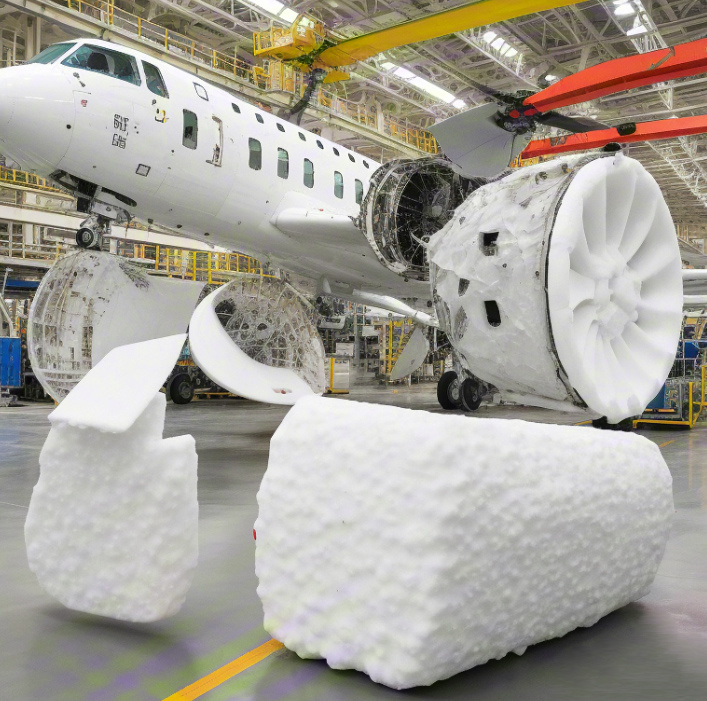
PMI Foam
Latest News