


Precision Processing: Mastering CNC Machining of PMI Foam
time:
2025-04-30 17:49
source:


PMI (Polymethacrylimide) foam is a high-performance, rigid, closed-cell foam widely used as a core material in advanced composite structures for aerospace, automotive, and drone applications. Its exceptional strength-to-weight ratio makes it ideal for creating lightweight yet robust components. However, working with such specialized materials requires precise manufacturing techniques. CNC machining is the primary method for shaping PMI foam cores to the exact specifications required for composite layups.
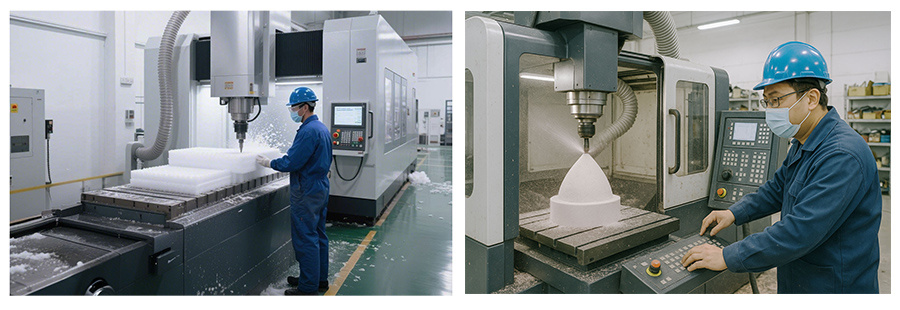
Why CNC Machining for PMI Foam?
While PMI foam is relatively easy to cut compared to metals, achieving the complex geometries, tight tolerances, and repeatable accuracy needed for modern composite parts demands automated precision. CNC machining offers:
- Accuracy and Repeatability: Essential for producing identical core parts, crucial for manufacturing consistency.
- Complex Shapes: Capability to create intricate contours, tapers, and internal features impossible with manual methods.
- Efficiency: Faster processing times for production runs once the program is set up.
- Reduced Material Waste: Optimized tool paths minimize scrap.
The CNC Machining Process for PMI Foam
Machining PMI foam isn't like cutting wood or plastic. Its unique properties require specific considerations:
- Tooling Selection: This is perhaps the most critical aspect. PMI foam is rigid but can generate heat if cut incorrectly, leading to melting or smearing.
- Sharpness is Key: Tools must be extremely sharp to slice cleanly rather than tear or push the material.
- Tool Geometry: Spiral O-flute cutters (often single or double flute) are common. The polished flutes help with chip (dust) evacuation. Diamond-coated tools can offer extended life when working with abrasive dust.
- Tool Material: High-speed steel (HSS) or solid carbide cutters are typically used. Carbide offers better wear resistance, especially at higher speeds.
- Sharpness is Key: Tools must be extremely sharp to slice cleanly rather than tear or push the material.
- Cutting Parameters (Speeds and Feeds): Finding the right balance is crucial to prevent heat build-up and ensure a clean finish.
- High Spindle Speeds: Often preferred to achieve a clean cut edge.
- Appropriate Feed Rates: Must be matched to the spindle speed and tool geometry to ensure a proper "chip load" – cutting a sufficient amount of material with each tooth pass. Too slow a feed can rub and generate heat; too fast can overload the tool or cause tearing.
- Experimentation: Optimal parameters often depend on the specific foam density, tool type, and machine rigidity, requiring some testing.
- High Spindle Speeds: Often preferred to achieve a clean cut edge.
- Dust and Chip Management: PMI foam machining produces a significant amount of fine, often static-prone dust.
- Effective Dust Collection: A robust vacuum system and proper shroud around the spindle are essential to capture dust at the source. Good ventilation in the workspace is also necessary for safety.
- Static Control: Anti-static measures may be needed to prevent dust from clinging to the material or machine components.
- Effective Dust Collection: A robust vacuum system and proper shroud around the spindle are essential to capture dust at the source. Good ventilation in the workspace is also necessary for safety.
- Workholding: Securing the foam block without crushing or deforming it is vital.
- Vacuum Tables: The most common method, providing even, non-marring clamping pressure across the surface.
- Light Clamping or Fixtures: Used when vacuum isn't feasible, requiring careful application of pressure.
- Vacuum Tables: The most common method, providing even, non-marring clamping pressure across the surface.
- Multi-axis Machining: For complex aerospace or drone components with 3D contours, 3-axis, 4-axis, or even 5-axis CNC machines are often employed. This allows for machining complex surfaces and undercuts in a single setup.
Benefits of Precisely Machined PMI Foam Cores
Using accurately CNC machined PMI foam cores directly impacts the quality and performance of the final composite part:
- Accurate Dimensions: Ensures the composite skins lay up correctly, minimizing voids or thickness variations.
- Perfect Fit: Cores match the mold or surrounding structure precisely.
- Optimized Weight and Strength: The core's geometry is exactly as designed for structural performance.
- Faster Layup: Consistent, accurate cores simplify the composite manufacturing process.
Conclusion
CNC machining is an indispensable technology for working with advanced materials like PMI foam. By carefully selecting tooling, optimizing cutting parameters, and implementing effective dust management and workholding strategies, manufacturers can precisely shape this lightweight core material. This precision in PMI foam processing is fundamental to producing the high-performance, lightweight composite structures essential for the next generation of aerospace vehicles, automotive components, and sophisticated drones.
PMI foam
Latest News